
Best Home Education Curriculum UK (2026): Free and Paid
The best home education curriculum in the UK by approach and key stage: free spines like Oak and BBC Bitesize, plus CGP, Schofield & Sims and Galore Park books.

There is no single best home education curriculum in the UK. Families in England do not have to follow a set curriculum. The law requires an efficient, full-time education suited to the child's age, ability and aptitude. Most families start with a simple maths and English spine, often combining free lessons from Oak National Academy and BBC Bitesize with a few CGP or Schofield & Sims workbooks. Projects, reading and trips fill out the week.
The sources for this guide include GOV.UK's home education page, section 7 of the Education Act 1996, Flybrite, Willowfolio, Homeschool Start Guide and the providers' own sites. This is an editorial guide, not a personal account or legal advice.
The short answer
- Best free spine: Oak National Academy for full lessons, with BBC Bitesize for short topics
- Best workbooks for a structured spine: CGP Targeted Question Books by year group
- Best for daily maths practice: Schofield & Sims Mental Arithmetic
- Best textbook route for confident readers: Galore Park So You Really Want to Learn Maths
- Best for a gentle, book-led approach: a Charlotte Mason plan such as the free Ambleside Online
- If 11+ is on the cards: Bond Assessment Papers
We may earn a commission if you buy through links on this page. It never changes our verdicts. How we review.
CGP KS2 Maths Year 3 Targeted Question Book
The law in one paragraph
GOV.UK says children must receive a full-time education from the age of 5, "but you do not have to follow the national curriculum". The council may make an informal enquiry to check that the education is suitable. Before starting, read GOV.UK's elective home education guidance for the latest rules. Check your local rules. This page is not legal advice. Updated 11 November 2026.
Pick your spine
| Approach | Key stage | Prep time | Typical cost a year (source) | Example resources | Best for |
|---|---|---|---|---|---|
| Structured (National Curriculum as a guide) | KS1 to KS3 | Low to medium | £0 to £200 (Homeschool Start Guide) | Oak, BBC Bitesize, White Rose Maths; CGP Targeted Question Books | Families new to home education or with a child returning to school later |
| Charlotte Mason | KS1 to KS2 mainly | Medium to high | £100 to £400 (Homeschool Start Guide) | Ambleside Online (free plan), living books from the library | Strong readers and families who love books and nature study |
| Eclectic (mixed) | Any | Medium | Between the two | Schofield & Sims for maths, Oak units for science, projects for the rest | Most families, per Flybrite and Homeschool Start Guide |
| Exam-focused (towards GCSEs) | KS3 to KS4 | Medium | Not stated by our sources; exam entry fees extra | Oak secondary lessons, CGP revision guides | Teenagers sitting GCSEs as private candidates |
| Online school | Any | Low | Fees vary; check each provider | Provider's own timetable | Families who want live teaching (no affiliate links) |
A sample week for a mixed-age family
Here is one possible weekly rhythm for a 7-year-old and an 11-year-old. It is an example, not an account of a particular family:
- Monday to Thursday mornings: 20 minutes reading together, followed by 20 minutes of maths each (Mental Arithmetic for the younger child, CGP or Galore Park for the older) and one Oak science or history lesson.
- Afternoons: time for a shared project, cooking, a walk with a nature notebook or a library visit.
- Friday: a trip, museum visit or home education group, followed by a quick look back at the week.
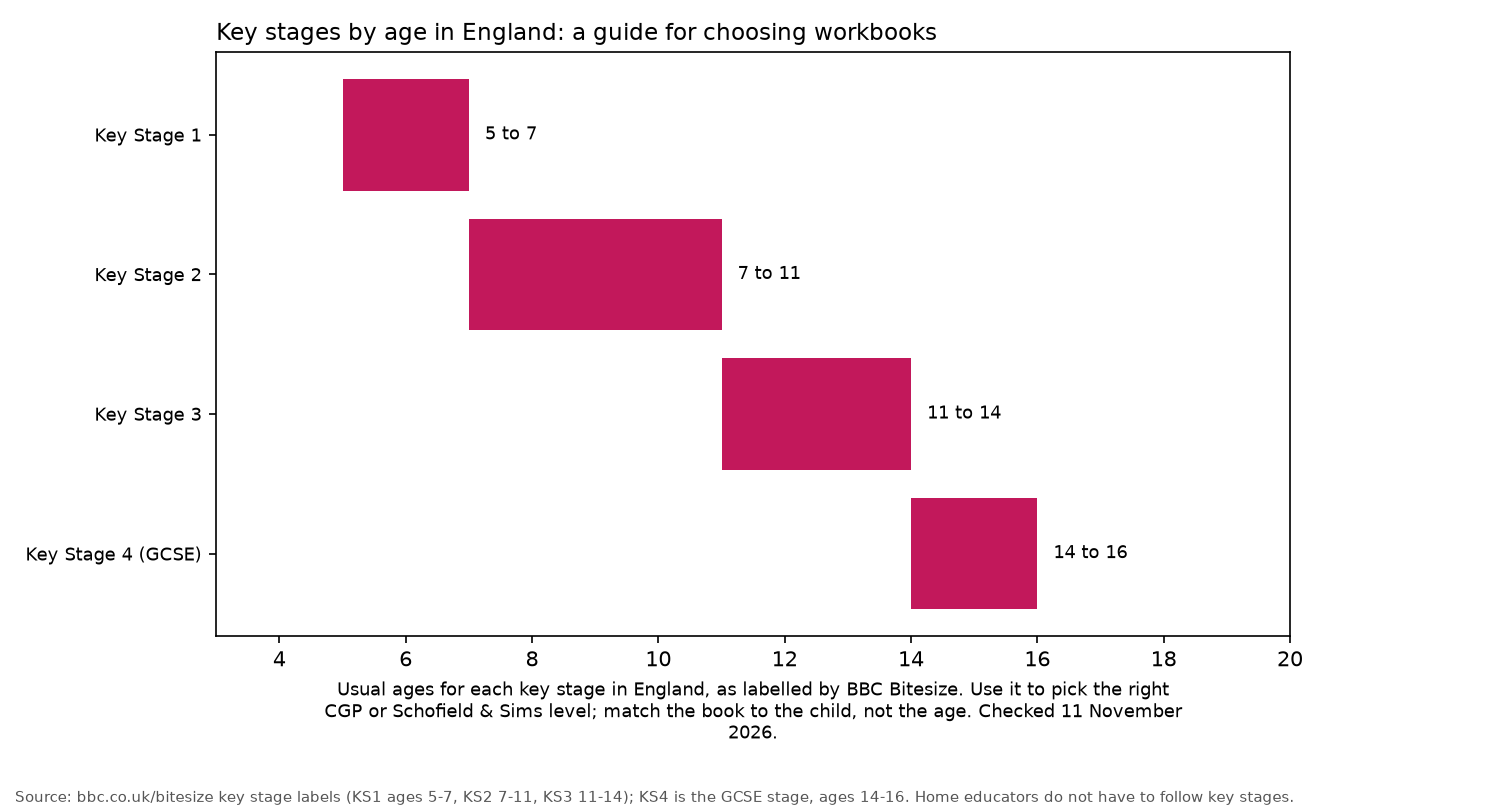
Free spines
- Oak National Academy: free lessons aligned with the National Curriculum and "designed by subject experts". Homeschool Start Guide notes that even Charlotte Mason families can pick individual lessons.
- BBC Bitesize: short guides, videos and games organised by age and key stage, covering KS1 through to GCSE.
- White Rose Maths: a maths scheme widely used in schools. Check which resources are free and which require a subscription.
- The National Curriculum: official programmes of study that can serve as a checklist, even if you choose not to follow them.
Books on Amazon
Amazon UK listings were checked on 11 November 2026. The CGP, Schofield & Sims and Bond books below were in stock and sold by Amazon. The Galore Park listing is covered in its own section.
CGP Targeted Question Books: best workbooks for a structured spine
CGP has a book for each subject and year group, making it easier to choose by a child's level rather than age. The Year 3 maths and English books were in stock and sold by Amazon on 11 November 2026.
Who it's for: families who prefer a clear page-a-day routine. Who it isn't for: children who dislike written work.
CGP KS2 Maths Year 3 Targeted Question Book
CGP KS2 English Year 3 Targeted Question Book
Schofield & Sims Mental Arithmetic: best daily maths practice
According to the listing, Book 1 covers arithmetic, number vocabulary and problem solving for Year 3, ages 7 to 8. The series continues into later years, with answer books sold separately. For practical maths activities, see the maths manipulatives guide.
Who it's for: building a short, regular maths habit. Who it isn't for: children who need new concepts explained from scratch.
Schofield & Sims Mental Arithmetic 1
Galore Park So You Really Want to Learn Maths: textbook route
The title positions this as a textbook for Key Stage 2 and Common Entrance. The answer book is separate. On 11 November 2026 the featured offer was a used copy sold by World of Books Ltd, not by Amazon, and the listing showed low stock. The count is not printed here. Check the seller and the condition on the product page.
Who it's for: confident readers who appreciate worked explanations. Who it isn't for: families looking for a quick workbook.
Galore Park So You Really Want to Learn Maths Book 1
Bond 11+ and CGP SATS books: only if exams are the goal
Bond's Maths Assessment Practice Papers (age 9 to 10, Book 1) are titled for GL Assessment 2026 and other 11 plus exams. CGP's Year 6 SATS Question Book covers the 2027 tests. Home-educated children do not sit SATs, although some families use these books as a Year 6 checkpoint.
Bond 11+ Maths Assessment Practice Papers Age 9-10 Book 1
CGP KS2 Maths Year 6 SATS Question Book
The living-books approach
Charlotte Mason was a British educator who worked in Ambleside, notes Homeschool Start Guide, which points families to Ambleside Online. The site offers free book lists organised by year. Most titles are available to borrow from a library. For reading lessons, choose one phonics or reading programme and stay with it. That topic deserves a guide of its own.
Subscriptions and online schools
Paid subscription schemes and online schools provide live or recorded lessons. Prices vary, as does what each provider counts as full-time, so check the individual terms. There are no affiliate links for these options.
Wales, Scotland and Northern Ireland
Home education rules are different outside England. Check the Welsh Government's elective home education pages, Scottish Government guidance and the Department of Education (NI). Check your local rules.
Keep the rest simple
A homeschool planner can help record what has been covered. Add a science kit for practical work, and set aside one afternoon for educational board games. Find more in the homeschool section.
FAQ
Do home educators have to follow the National Curriculum?
No, not in England. GOV.UK states that "you do not have to follow the national curriculum".
What is the best free homeschool curriculum in the UK?
Oak National Academy offers the fullest free option, with BBC Bitesize as a useful companion.
How much does home education cost?
According to Homeschool Start Guide, a National Curriculum-style approach costs £0 to £200 a year, compared with £100 to £400 for Charlotte Mason, before exam fees.
What do most UK home educators use for maths?
The sources point to White Rose Maths, Oak lessons and workbooks from CGP and Schofield & Sims.
Can home-educated children sit GCSEs?
Yes. Flybrite notes that home-educated children can enter as private candidates at an exam centre. Fees and available centres vary.
More from In the Trenches of Motherhood: Homeschool · Homeschool planners · How we review