
Best Books to Teach a Child to Read at Home
The best books to teach a child to read at home, in stage order: phonics sound cards, decodable readers and first reading scheme sets, with UK and US options.

The best books to teach a child to read at home follow the same progression used in schools. Start with letter sounds, move on to decodable books that let children practise blending those sounds, then introduce a reading scheme. For most UK families, that means beginning with Read Write Inc. or Jolly Phonics, moving on to Dandelion or Songbirds readers, and eventually introducing Biff, Chip and Kipper. Buy one stage at a time and move on when the child is ready.
This guide draws on the Department for Education's Reading Framework, Oxford Owl's Read Write Inc. parent guide, Homeschool Start Guide, Dulcarnon's decodable reader reviews, Reading Chest and Amazon UK listings. The editorial team has not tested these books.
Quick picks
- Best UK phonics start: Read Write Inc. Home Set 1 Speed Sounds flashcards, or Jolly Phonics Pupil Book 1
- Best first decodable readers: Dandelion Readers Set 1
- Best-loved decodable readers: Julia Donaldson's Songbirds
- Best all-in-one programme (US): Teach Your Child to Read in 100 Easy Lessons
- Best next step: Biff, Chip and Kipper Stage 2 (Read with Oxford)
- Best for reluctant readers: Usborne Phonics Readers
We may earn a commission if you buy through links on this page. It never changes our verdicts. How we review.
Read Write Inc. Home Set 1 Speed Sounds flashcards
Dandelion Readers Set 1, Units 1 to 10
Stage path: buy one thing at a time
| Age (guide) | Stage | What to use | Decodable or read-aloud | UK option | US option |
|---|---|---|---|---|---|
| 3 to 5 | Learning letter sounds | Sound cards or a pupil book | Not a reader yet | RWI Set 1 Speed Sounds cards; Jolly Phonics Pupil Book 1 | 100 Easy Lessons (lessons start here) |
| 4 to 5 | Blending simple words (s-a-t, sat) | First decodable books | Decodable, child reads | Dandelion Readers Set 1; RWI Red Ditty books | BOB Books Collection 1 |
| 4 to 6 | Two-letter sounds (sh, ch, ee) | Graded decodable stories | Decodable, child reads | Songbirds stages 1 to 2 | 100 Easy Lessons (later lessons) |
| 5 to 6 | Wider reading | Reading scheme sets | Mostly decodable, adult nearby | Biff, Chip and Kipper Stage 2 | None in this guide |
| Any age | Love of stories | Picture books and phonics readers | Read aloud together | Usborne Phonics Readers | None in this guide |
The ages above come from customer or publisher age ranges in the listings. Treat them as a guide rather than a rule. The sounds a child already knows are a better way to choose a book than their birthday. Homeschool Start Guide also encourages reading richer books aloud alongside phonics practice.
Phonics in two minutes
- Synthetic phonics teaches children to read by blending the sounds represented by letters. The DfE's Reading Framework explains the department's position on systematic synthetic phonics and emphasises the importance of following one programme consistently.
- Decodable books contain only the sounds a child has already been taught. This means they can work out every word rather than relying on guesswork. Reading Chest describes these books as the key to building genuine confidence.
- Do not guess from pictures. Reading Chest advises against encouraging children to guess words from pictures or context. This can develop habits that work against phonics. Instead, cover the picture, read the words first, then look at the illustration.
- Pure sounds. Oxford Owl recommends saying "mmm" rather than "em". It also suggests reading each book three times: first for accuracy, then fluency, and finally in a storyteller voice.
The picks
Read Write Inc. Home Set 1 Speed Sounds flashcards: best UK phonics start
Ruth Miskin's flashcards cover the 31 Set 1 Speed Sounds, per the listing. The listing title says ages 4 to 6, and a customer reading-age line says 3 to 5 years. Homeschool Start Guide says Read Write Inc. is used in about a third of UK primary schools, so these cards match what many classrooms use. Oxford Owl also provides free eBooks and parent films to support the programme.
Who it's for: children around the ages on the listing, and families whose children already use Read Write Inc. at school and need extra practice at home. Who it isn't for: anyone looking for a complete, scripted reading course in a single book.
Read Write Inc. Home Set 1 Speed Sounds flashcards
Jolly Phonics Pupil Book 1: best multi-sensory start
This write-in book introduces the 42 main letter sounds, with a story and action for each one, alongside the first tricky words, per the listing. The listing reading age is 3 to 6 years. It suits children who learn through movement and song, says Homeschool Start Guide. It is the British English edition, with print letters.
Who it's for: lively 3 to 6 year olds. Who it isn't for: children whose school follows Read Write Inc. It is better to stick with one scheme rather than mix programmes.
Jolly Phonics Pupil Book 1 (print letters)
Dandelion Readers Set 1: best first decodable readers
This set contains ten short books for children taking their first steps with blending. According to the listing, the first book uses only the sounds s, a, t, i and m. Dulcarnon, a home-education blog, describes Dandelion as the most decodable scheme it has found, with particularly fine progression between stages. The Amazon UK featured offer is an import and may ship from abroad. Amazon's import terms say a product sold from abroad may differ from a local copy, including labelling, and that the manufacturer warranty will not apply.
Who it's for: children who are just beginning to blend sounds into words. Who it isn't for: confident blenders. The stories are simple by design.
Dandelion Readers Set 1, Units 1 to 10
Julia Donaldson's Songbirds: best-loved decodable readers
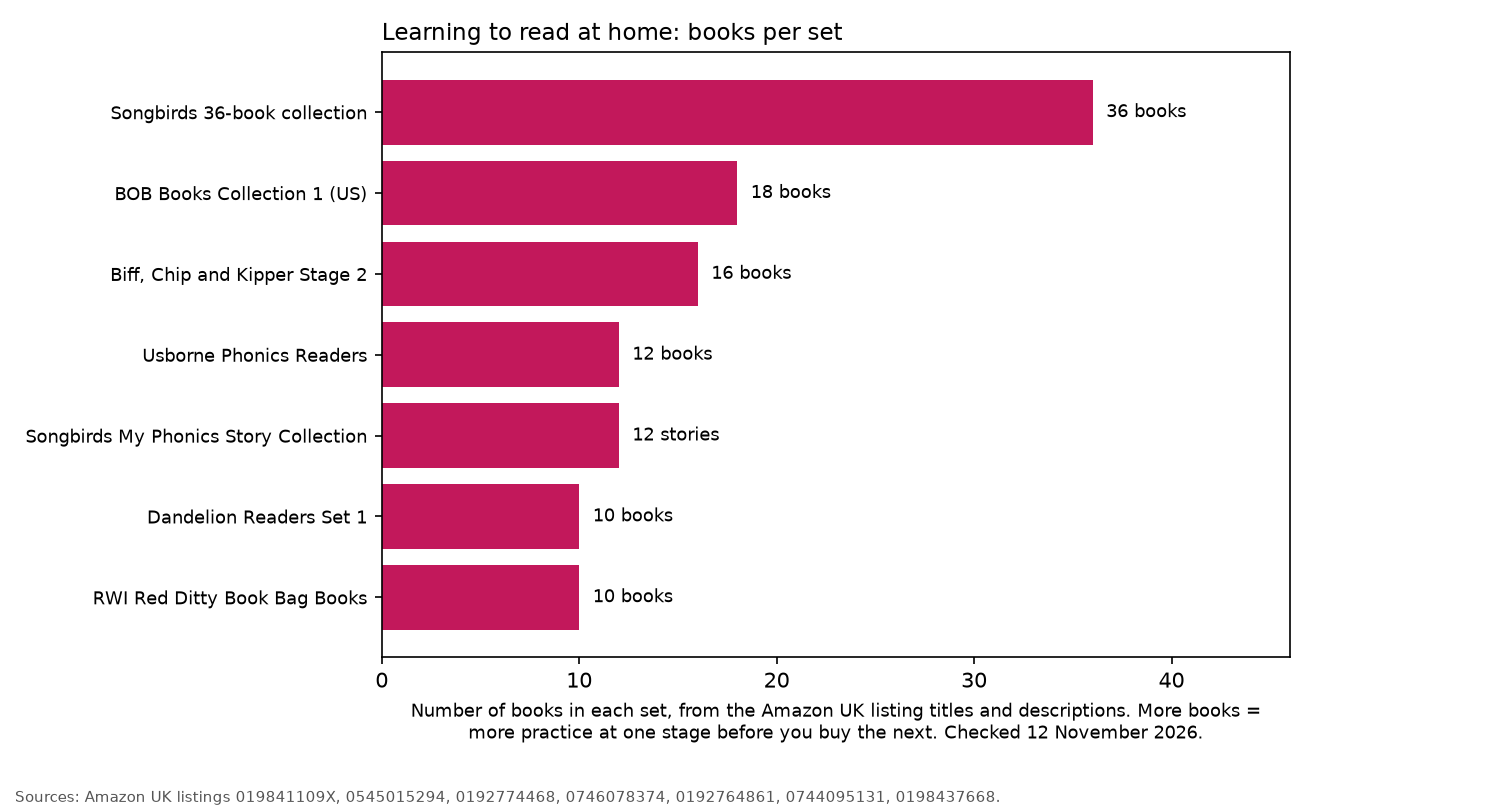
The Stages 1 to 2 story collection contains 12 phonics stories, according to the listing, while the larger 36-book collection covers stages 1 to 4. A customer reading-age line on the 12-story set says 4 to 5 years. Dulcarnon considers these the most enjoyable decodable readers it has tried, but warns that the activity books and bundles use different stage numbering from the readers. Check the stage before you buy. The 36-book set's featured offer is from a third-party seller.
Who it's for: children who are ready for stories with a little more variety. Who it isn't for: families looking for non-fiction reading material. Dulcarnon notes that the series does not include any non-fiction.
Songbirds My Phonics Story Collection (Stages 1 to 2)
Songbirds 36-book collection (Stages 1 to 4)
Teach Your Child to Read in 100 Easy Lessons: best all-in-one programme (US)
This programme is from Avid Reader Press / Simon & Schuster. The listing calls it a revised and updated second edition, at 420 pages, with a practice guide. The publisher says each lesson takes twenty minutes a day. It is a US title, so spellings and phonics terms are American. It is listed on Amazon UK and may ship as an import. The teaching sequence will not match a UK classroom scheme.
Who it's for: home educators who want a fully scripted programme with lessons laid out for them. Who it isn't for: families whose children are learning Read Write Inc. or Jolly Phonics at school.
Teach Your Child to Read in 100 Easy Lessons (US)
Biff, Chip and Kipper Stage 2: best next step
This 16-book Read with Oxford set is marked 4+ on the listing. It features the familiar Oxford Reading Tree characters and provides a next step for children who have started blending. The featured offer is from a third-party seller. For additional practice with more strictly decodable books, the Read Write Inc. Red Ditty Book Bag Books are available as a separate 10-book pack.
Who it's for: children who can already blend sounds and are ready for more recognisable stories. Who it isn't for: beginners who are still learning individual letter sounds.
Biff, Chip and Kipper Stage 2 (16 books)
Read Write Inc. Red Ditty Book Bag Books (10)
Usborne Phonics Readers: best for reluctant readers
This 12-book set is by Phil Roxbee Cox, with illustrations by Stephen Cartwright. Read them together to keep reading fun. The featured offer is from a third-party seller. For families looking for a US alternative, BOB Books Collection 1 is a box of 18 beginner books. It is a US title, so spellings and phonics terms are American. On Amazon UK the featured offer is an import. It may ship from abroad. Amazon's import terms say a product sold from abroad may differ from a local copy, including labelling and the language of the instructions, and that the manufacturer warranty will not apply.
Who it's for: children who need a little more fun and encouragement to enjoy reading. Who it isn't for: children looking for their very first decodable book.
Usborne Phonics Readers 12-book set
BOB Books Collection 1 (US)
A short daily routine
Homeschool Start Guide recommends 15 to 20 minutes of phonics practice every day for children of Reception and Year 1 age:
- Review: Go through the sounds the child already knows using flashcards.
- Teach: Introduce one new sound.
- Practise: Blend a few words containing that sound.
- Read: Choose a decodable book and read it three times over the week.
Short, regular sessions are more useful than trying to fit everything into one long weekend lesson. If a Christmas present is the aim, any of the stage sets above could fit, as long as it matches the sounds the child is learning. See also the educational Christmas gifts list.
FAQ
What age should a child start phonics?
Schools in England introduce phonics in Reception, when children are aged 4 to 5. Listings for first sound cards start from about age 3.
Is 100 Easy Lessons any good?
It can be a good fit for home educators who prefer a fully scripted approach. It is a US-published programme, so a copy may ship as an import, and its teaching sequence will not match the scheme used by a UK school.
What are decodable books?
Books that use only the sounds a child has already learned, so the child can sound out every word rather than guess.
Which reading scheme do UK schools use?
Many schools use Read Write Inc. Homeschool Start Guide puts it at about a third of primary schools. Others use Jolly Phonics or Phonics Bug.
More from In the Trenches of Motherhood: Homeschool · Kids · Best home education curriculum UK · Homeschool planners · Educational board games · How we review