
Best Handwriting Workbooks for Kids, by Age (UK)
UK handwriting workbooks by age: Collins, Little Wandle, Schofield & Sims and CGP, with publisher ages and a stage ladder.
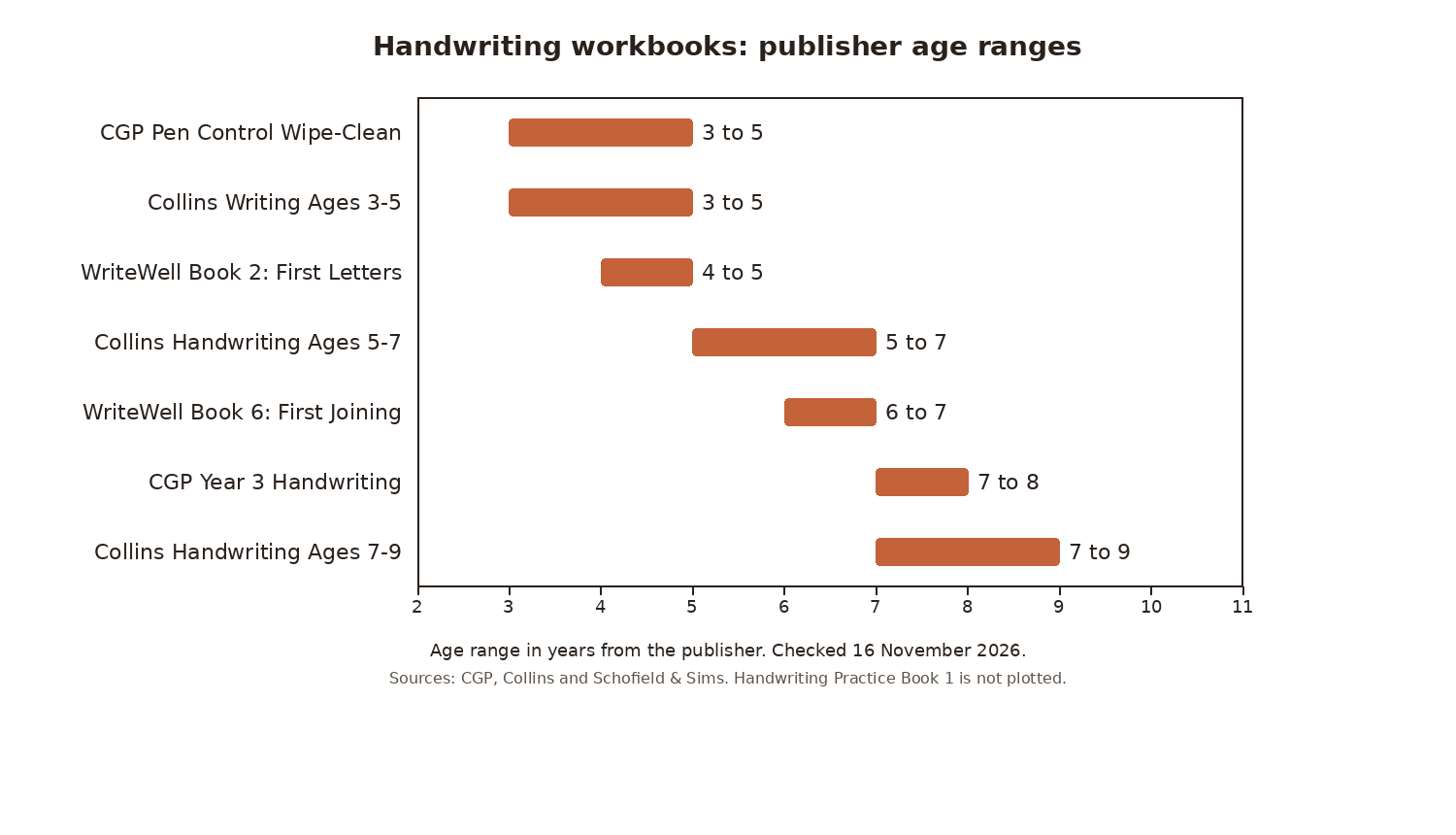
A handwriting workbook is a better fit when it matches the stage a child is at and the letter style taught at school. For children around 3, that can mean a wipe-clean pen control book. For first letters, Collins Easy Learning or a Little Wandle workbook is the sort of book publishers aim at that stage. Once letters are formed, a joining book such as Collins Handwriting Ages 7 to 9 is a later step. The minutes in this guide are a suggested starting point.
This guide draws on the national curriculum English programme of study, the National Handwriting Association's ages and key stages page, Collins' Little Wandle handwriting pages, Schofield & Sims' handwriting range, CGP's handwriting books and the Amazon UK listings linked below. Age ranges are the publishers' own. The editorial team has not tested these books.
Quick picks by age
- Ages 3 to 5, pen control: CGP Pen Control Wipe-Clean Activity Book (with pen). CGP's title gives ages 3 to 5.
- Ages 3 to 5, first writing: Collins Easy Learning Writing Ages 3 to 5
- Reception, school-matched: Little Wandle Handwriting Workbook 2: Lower-case letters
- Ages 4 to 5: Schofield & Sims WriteWell Book 2: First Letters
- Ages 5 to 7: Collins Easy Learning Handwriting Ages 5 to 7
- Ages 6 to 7, first joins: Schofield & Sims WriteWell Book 6: First Joining
- Ages 5 to 7, extra letter formation: Schofield & Sims Handwriting Practice Book 1. That age is from the publisher's page. It is not on the chart.
- Ages 7 to 9: Collins Easy Learning Handwriting Ages 7 to 9
- Ages 7 to 8, Year 3 joins: CGP Year 3 Handwriting
- Pencil, separate left and right versions: STABILO EASYgraph
We may earn a commission if you buy through links on this page. It never changes our verdicts. How we review.
Collins Easy Learning Handwriting Ages 5 to 7
CGP Pen Control Wipe-Clean Activity Book Ages 3 to 5
Age and stage ladder
Start from the skill a child can manage, not from age alone. The National Handwriting Association's key stage table puts the Early Years Foundation Stage at ages 0 to 5 (nursery to Reception), Key Stage 1 at 5 to 7 (Years 1 and 2) and Key Stage 2 at 7 to 11 (Years 3 to 6). Workbook ages in the table are the publishers' own and do not always line up with a single school year.
| Stage | Skill to build | Workbook pick | Letter style | Suggested minutes a day |
|---|---|---|---|---|
| 1. Pen control (CGP ages 3 to 5) | Lines, curves and the shapes inside letters | CGP Pen Control Wipe-Clean | Shapes and patterns, then letters (CGP) | 5 |
| 2. First letters (WriteWell ages 4 to 5) | Lower-case letters from a clear start point | Little Wandle Workbook 2 or WriteWell Book 2 | Print, as taught in Reception | 5 to 10 |
| 3. Letters and digits (Year 1) | Lower-case letters, capitals and digits 0 to 9 | Collins Handwriting Ages 5 to 7 | Letter formation, before Year 2 joins | 10 |
| 4. First joins (Year 2, WriteWell ages 6 to 7) | Diagonal and horizontal joins | Schofield & Sims WriteWell Book 6 | Joined, as the school teaches | 10 |
| 5. Fluent joining (Years 3 and 4) | Legibility, size and spacing | Collins Handwriting Ages 7 to 9, or CGP Year 3 (ages 7 to 8) | Joined | 10 to 15 |
The year-group skills are from the national curriculum for England. In Year 1, pupils are taught to sit correctly, hold a pencil comfortably, begin to form lower-case letters in the correct direction, form capital letters, form digits 0 to 9, and practise letters in handwriting families. In Year 2, pupils start using some of the diagonal and horizontal strokes needed to join letters, and learn which letters are best left unjoined. In Years 3 and 4, pupils use those joins and work on legibility, consistency and quality. The curriculum says handwriting needs frequent, direct teaching. It does not set a number of minutes.
The suggested minutes are a starting point for a short session. A short session that stops while the work is still going well is easier to repeat than a long one. That is a suggestion from this guide, not a result from a trial.
The National Handwriting Association's ages page quotes Ofsted's Research Review Series: English (2022). As quoted there, formal handwriting teaching does not need to start before Reception, and children at the end of the Early Years Foundation Stage should be able to hold a pencil effectively, using the tripod grip in almost all cases.
Match the school's scheme: checklist
- Ask the class teacher which handwriting scheme the school uses.
- Ask whether the class learns print first or pre-cursive letters with lead-in strokes.
- Check which letters need an exit flick and which should stay unjoined. Year 2 of the national curriculum includes that distinction.
- Match the capital letters and digit shapes taught at school.
- The national curriculum says left-handed pupils should receive specific teaching. Tell the teacher, and use a left-handed pencil and the paper position below at home as well.
What matters
- Letter style. Print, pre-cursive and continuous cursive do not look the same. A workbook that forms letters differently from school is a mismatch. Choose the book that follows the school's approach.
- Phonics link. Collins says Little Wandle Handwriting works alongside the Little Wandle systematic synthetic phonics progression, and that it covers the Early Learning Goals and the national curriculum.
- Left-handed children. Alison Harris, an occupational therapist, writes in Teaching Left Handers to Write (hosted on the National Handwriting Association website) that the paper should line up with the lower arm so the wrist stays neutral. Her tips put the edge of the paper, or the middle of the book, slightly to the left of the child's midline, and the pencil a little higher up the shaft than for a right-hander. STABILO makes separate left-handed and right-handed EASYgraph pencils.
- Short and often. Five to fifteen minutes is the suggested range in the table. The national curriculum calls for frequent practice and does not name a daily total.
The picks
CGP Pen Control Wipe-Clean Activity Book (ages 3 to 5)
CGP titles this a pen control book for ages 3 to 5, with a wipe-clean pen in the book. CGP says it covers shapes and patterns found in letters, then moves on to writing full letters, with arrows for each shape or letter. Pages can be wiped and used again.
Who it's for: children still building pen control, including those starting on letters. Who it isn't for: children who are already joining.
CGP Pen Control Wipe-Clean Activity Book Ages 3 to 5
Collins Easy Learning Writing Ages 3 to 5
Collins titles this workbook Writing Ages 3 to 5, in the Easy Learning Preschool range. The Amazon UK listing says it is for the Early Years Foundation Stage and for learning at home. Collins' Easy Learning page lists a Writing Workbook Ages 3 to 5 in that preschool range.
Who it's for: children making first letter shapes at home before school. Who it isn't for: a class that teaches a different letter style. Check the school's scheme first.
Collins Easy Learning Writing Ages 3 to 5
Little Wandle Handwriting Workbooks
Collins publishes these as a numbered series with Little Wandle. Workbook 2 is lower-case letters. On the Amazon UK listing, the comparison table titles Workbook 1 Patterns and Workbook 2 Lower-case letters, and the year-group row marks both as Reception. Workbook 9 is Develop Fluency in Joining Letters. Workbook 8, linked below, is the joining-letters book. The Amazon UK description says it teaches each join type, with sentence practice.
Collins says the programme works alongside the Little Wandle phonics progression.
Who it's for: children learning Little Wandle phonics at school. Who it isn't for: families who want one workbook for every stage. This is a numbered series.
Little Wandle Handwriting Workbook 2: Lower-case letters
Little Wandle Handwriting Workbook 8: Joining letters
Schofield & Sims WriteWell Book 2: First Letters (ages 4 to 5)
Schofield & Sims describes WriteWell as a set of pupil books from Reception to Year 6, in small stages. On the publisher's list, Book 2 is First Letters, ages 4 to 5, and Book 6 is First Joining, ages 6 to 7. The Amazon UK description of Book 2 says children learn some letters of the alphabet in that book, with the rest in Book 3. The Book 6 description says first joins start with basic horizontal and diagonal joins.
Who it's for: children who do better with one small step at a time. Who it isn't for: families who want the colourful illustrated pages Collins describes in Easy Learning. Schofield & Sims describes WriteWell as focused practice.
Schofield & Sims WriteWell Book 2: First Letters
Schofield & Sims WriteWell Book 6: First Joining
Collins Easy Learning Handwriting Ages 5 to 7
The Amazon UK listing is titled Handwriting Ages 5 to 7, in Collins Easy Learning KS1, and the description says it supports learning at home. Collins gives the level as KS1 English. The book is for extra practice across those publisher ages, which cover Year 1 and Year 2, so it is not only a joining book.
Who it's for: Year 1 and Year 2 children who need more handwriting practice at home. Who it isn't for: children who are already joining with confidence. WriteWell Book 6 or a Years 3 and 4 book is the later step.
Collins Easy Learning Handwriting Ages 5 to 7
Schofield & Sims Handwriting Practice Book 1 (ages 5 to 7)
Schofield & Sims lists Handwriting Practice 1 for ages 5 to 7. The publisher says it focuses on letter formation, introduces capital letters, and is compatible with any school handwriting scheme. The same age, 5 to 7, is on the Handwriting Practice series page.
The Amazon UK title prints a different age range, so this book is not on the chart. Use the publisher's ages 5 to 7, and read the title on the product page before you order.
Who it's for: children who need more letter-formation practice beside school books. Who it isn't for: families looking for the colourful activity pages Collins describes. Schofield & Sims calls this book's format simple.
Schofield & Sims Handwriting Practice Book 1
Collins Easy Learning Handwriting Ages 7 to 9 and CGP Year 3 Handwriting
Collins titles the Easy Learning book Handwriting Ages 7 to 9 and labels it KS2 English for learning at home. CGP describes the Year 3 Targeted Practice Book as joined-up handwriting for Year 3 pupils, ages 7 to 8. The two publisher ranges are not the same. CGP is the narrower, Year 3 book. Collins is the wider 7 to 9 book.
Who it's for: children in Years 3 and 4 whose joining is still slow or untidy. Who it isn't for: younger children who are still forming single letters.
Collins Easy Learning Handwriting Ages 7 to 9
CGP KS2 English Year 3 Handwriting Targeted Practice Book
STABILO EASYgraph pencil
STABILO describes the EASYgraph as a thick triangular pencil with non-slip grip moulds, in separate versions for left-handed and right-handed children. The Amazon UK title for the left-handed button is a pack of 6, petrol, HB. The right-handed title is a pack of 12, petrol, HB. They are not the same pack size.
Who it's for: children who need a shaped pencil while they learn the tripod grip, including left-handers. Who it isn't for: anyone who needs a standard hexagonal pencil. STABILO contrasts the triangular barrel with a traditional hexagonal pencil.
STABILO EASYgraph pencil, left-handed
STABILO EASYgraph pencil, right-handed
This listing is sometimes sold by a third-party seller; check the seller and delivery at checkout.
A suggested 10-minute routine
This is a suggested routine, not a record of a session. Ten minutes matches the starting point in the table for Year 1 and Year 2.
- Warm up (about 2 minutes). Finger movements, or large shapes in the air or on a whiteboard.
- Posture (about 30 seconds). Feet flat, back against the chair, paper slightly turned, the other hand holding the paper. For a left-hander, use Alison Harris's paper position above.
- Grip. A tripod grip near the pencil tip. The national curriculum says the pencil or pen should not be too large for a young pupil's hand, and that the child should be able to hold it easily. If fingers slide down, a chunkier pencil is the kind of tool Alison Harris discusses.
- One page (about 5 minutes). One workbook page, with the movement said aloud, such as "start at the top, down, and flick".
- Best letter (about 1 minute). The child circles the letter they are most pleased with.
For the skills expected at each key stage, use the National Handwriting Association's ages and key stages page beside the national curriculum. The statutory lines on this page follow the GOV.UK programme of study.
For more home learning, see the homeschool hub, plus guides to books to teach a child to read, homeschool planners, home education curriculum in the UK and choosing a printer for homeschool.
FAQ
What is a good handwriting book for a 5 year old?
Collins titles its Easy Learning handwriting workbook for ages 5 to 7. If the school uses Little Wandle, Workbook 2 is the lower-case letters book, and Collins' comparison table on the Amazon UK listing marks it as Reception.
How can handwriting be practised at home?
A suggested starting point is about ten minutes a day: a short warm-up, a check of posture and pencil grip, then one workbook page in the same letter style as school. The national curriculum asks for frequent practice and does not set a number of minutes.
When should children start joined-up writing?
In the national curriculum for England, Year 2 is when pupils start using some of the diagonal and horizontal strokes needed to join letters. Year 1 is about forming lower-case letters, capitals and digits.
Print or cursive first?
Follow the school. The national curriculum teaches letter formation in Year 1 and introduces joining strokes in Year 2. Some schools teach pre-cursive letters earlier. Ask which style the class uses.
Can Little Wandle handwriting be used at home?
Collins sells the workbooks, and the programme works alongside the Little Wandle phonics progression. Home practice can follow that sequence when the school uses Little Wandle. The editorial team has not used the books in a classroom.
More from In the Trenches of Motherhood: Homeschool · How we review