
Best Globes for Kids UK (2026)
By age
- 1 to 3
- 3 to 5
- 5 to 8
- 8 to 12
The best globe for most children aged 5 to 9 is the LeapFrog Magic Adventures Globe, with illuminated, raised-relief and inflatable alternatives and an age-fit table. Specs come from UK listings and named reviews, checked 19 November 2026. The editorial team has not tested these globes.

The best globe for kids UK families can buy for most children aged 5 to 9 is the LeapFrog Magic Adventures Globe. This 10-inch globe has a stylus, a small screen, three games and more than five hours of BBC video, with no app or tablet needed.
For a traditional globe that also works as a lamp, the illuminated National Geographic Classic is a good choice. Older children who want more detail may prefer the Oxford 30cm raised-relief globe, while an inflatable globe suits younger children who learn through movement. Start with the age-fit table to match features to the child.
Specs, ages and safety notes come from the UK Amazon listings and maker information, checked on 19 November 2026, plus published reviews that we credit by name. The editorial team has not tested these globes. This guide brings published information together.
Jump to: Quick picks · Age-fit table · The globes · How to choose · FAQ
We may earn a commission if you buy through links on this page. It never changes our verdicts. How we review.
Quick picks
- Best overall (smart globe, 5+): LeapFrog Magic Adventures Globe
- Best illuminated globe: National Geographic Classic Globe, 30 cm
- Best for older children: Oxford 30cm Desktop Globe with Raised Mountains
- Budget desk globe: EXERZ 20cm Educational World Globe
- Best for active learning: Brainstorm Toys 50cm Inflatable Globe
- Puzzle globe (6+): Ravensburger 3D Puzzle Ball Globe, 180 pieces
LeapFrog Magic Adventures Globe.
National Geographic Classic illuminated globe, 30 cm.
Age-fit table: what to look for at 5 to 7, 8 to 11 and 12+
The national curriculum for geography in England includes globes at every key stage. It is a helpful starting point for deciding what a child's globe should show.
The age groups below broadly follow the key stages. The features are our own suggestions.
| Age | What the curriculum covers | Features to look for | Globes on this page that fit |
|---|---|---|---|
| 5 to 7 (key stage 1) | The world's 7 continents and 5 oceans; the four countries of the UK and their capital cities; hot and cold areas in relation to the Equator and the poles | Big, bright continents; few labels; touch or talk features; a globe they can hold or throw | LeapFrog Magic Adventures (5+), Learning Resources inflatable (3 to 7), Brainstorm inflatable |
| 8 to 11 (key stage 2) | Latitude, longitude, the Equator, the hemispheres, the Tropics of Cancer and Capricorn, the Arctic and Antarctic Circle, the Prime/Greenwich Meridian and time zones | Printed latitude and longitude lines; a graduated meridian; political and physical detail | National Geographic Classic, Brainstorm inflatable (lines printed), EXERZ 20cm (bullets say 8+), Ravensburger puzzle globe |
| 12+ (key stage 3) | Building on knowledge of globes, maps and atlases, and using that knowledge routinely | 30 cm or larger; thousands of place names; raised relief; a sturdy metal meridian | Oxford 30cm raised relief, National Geographic Classic |
If one globe needs to suit two children, choose for the older child and consider an inflatable globe for the younger one. Always check the age guidance and safety warnings on the listing before buying.
LeapFrog Magic Adventures Globe: best smart globe
The UK listing gives a 10-inch globe with a tap-anywhere stylus, "thousands of facts", three games and more than five hours of BBC video. The age range says 5+, and the manufacturer recommended age is 5 to 11. Four AA batteries are included. NurseryPicks chose it as its overall pick because the learning tools are built in rather than relying on a phone, and notes the 2.7-inch colour screen and a footprint of about 11.1 by 10.2 by 14.1 inches.
AIToys.co.uk praises the "brilliant video content" and the privacy design (no camera, microphone, account or internet connection on the device). Its cons: optional adventure packs need PC software that "can be temperamental", the 2.7-inch display is for one or two children, and there is no rechargeable pack in the box.
Who it's for: children of about 5 to 9 who enjoy learning through tapping, videos and quizzes. That 5 to 9 band is our suggestion. The listing age is 5+, and the manufacturer recommended age is 5 to 11.
Who it isn't for: families looking for a simple reference globe with printed labels.
LeapFrog Magic Adventures Globe.
National Geographic Classic Globe: best illuminated globe
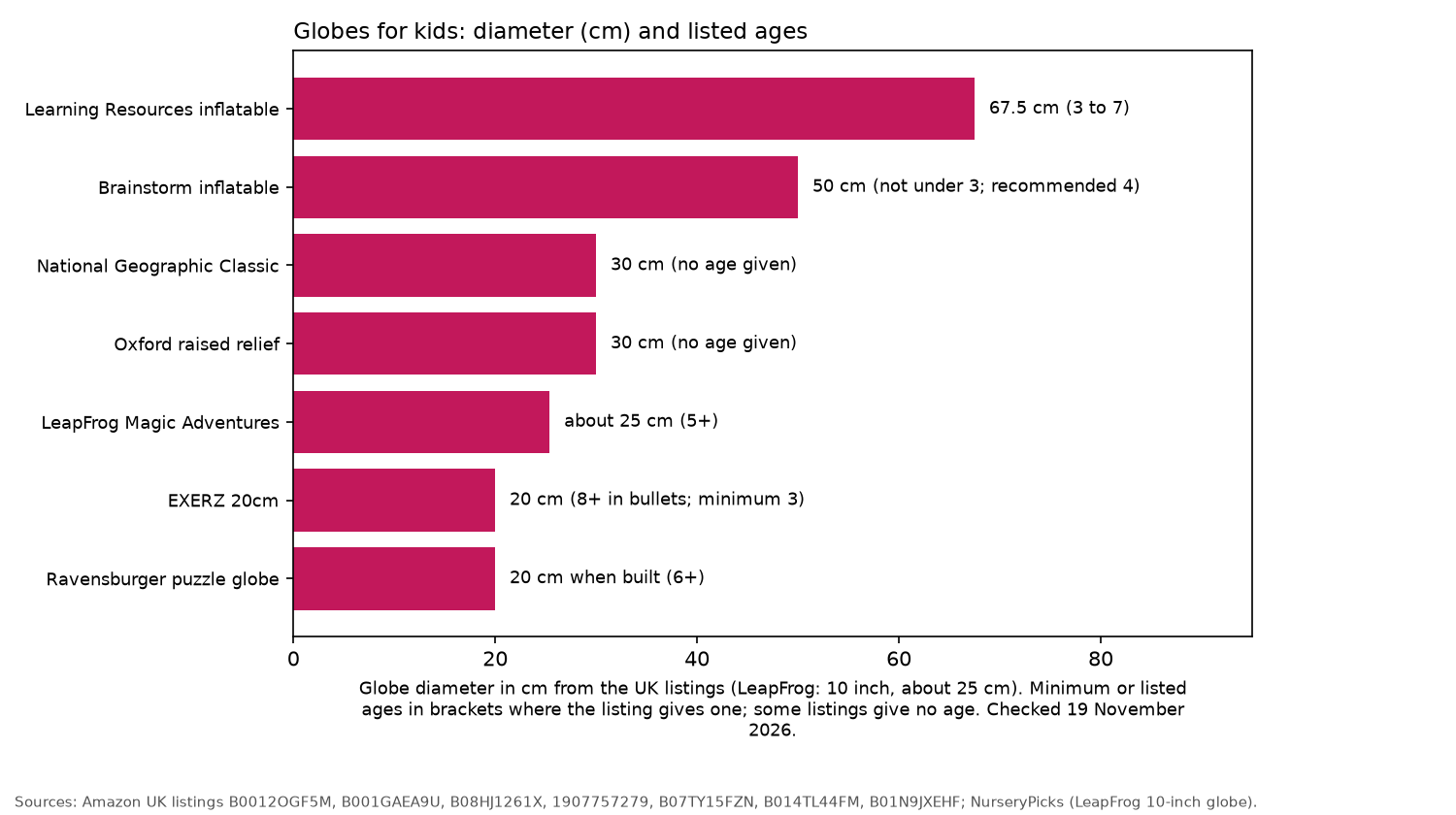
Made and designed by Tecnodidattica in Italy, this 30 cm globe uses official National Geographic cartography that is both political and physical, in English. An internal LED light turns it into a desk lamp, borders are picked out in different colours, and a graduated meridian helps with longitude. The listing does not give a minimum age.
Who it's for: a bedroom or homeschool desk where the globe can be useful for years.
Who it isn't for: very young children who are likely to handle it roughly.
National Geographic Classic illuminated globe, 30 cm.
Oxford 30cm Desktop Globe: best for older children
This is the detailed option. The listing gives raised mountain ranges, over 4,000 place names in English, a die-cast metal meridian and a solid hardwood base, assembled in the UK. The title describes an antique ocean, which is less bold than a globe made for young children. It suits secondary-age study and GCSE work better than a 6-year-old's first globe. That 12+ fit is our suggestion, and the listing gives no age.
Who it's for: children aged 12 and over, or families wanting a reference globe.
Who it isn't for: younger learners who need bold colours and fewer labels.
Oxford 30cm Desktop Globe with Raised Mountains.
EXERZ 20cm Educational World Globe: budget desk globe
A small self-assembly globe on a stand, 30 cm tall including the stand. The bullets describe an English political map with countries, borders, capital cities, oceans and continents, and suggest it for learners aged 8+. The listing's safety section gives a minimum age of 3 and says it should be used under the direct supervision of an adult.
Who it's for: a first desk globe for homework without spending much.
Who it isn't for: children who want physical geography features or an illuminated globe.
EXERZ 20cm Educational World Globe.
Inflatable globes: best for active learning
Inflatable globes are light, easy to store and good for throwing games. The Brainstorm Toys 50cm Inflatable Globe has a political map with longitude and latitude lines and comes with game ideas. The Learning Resources Giant Inflatable Labelling Globe is bigger at 67.5 cm, includes a pump and repair kit, and is listed for ages 3 to 7.
On safety, both listings carry a choking hazard warning for small parts and say they are not suitable for children under 3, with adult supervision. Brainstorm's listing gives a recommended age of 4, and the manufacturer minimum age is 4.
Brainstorm Toys 50cm Inflatable Globe.
Learning Resources Giant Inflatable Labelling Globe.
Ravensburger 3D Puzzle Globe: best puzzle globe
A 180-piece globe of curved plastic pieces that click together without glue and measures 20 cm when built. It shows continents, countries and animals, and is listed for children aged 6 and up (the details table gives 7 to 18, and a toy-safety line gives a recommended age of 7). The listing warns it is not suitable for children under 36 months because of small parts, with adult supervision recommended. It also says not to aim it at eyes or face.
Ravensburger 3D Puzzle Ball Globe, 180 pieces.
How to choose a globe for a child
- Interactive or plain: Smart globes teach through prompts and video. A plain printed globe is better for reading labels and doing homework.
- Size: A 30 cm globe is the classic desk size with room for detail. A 20 cm globe saves space but shows less.
- Political or physical: Political maps show countries and borders, while physical maps show mountains and terrain. The National Geographic Classic combines both, and the Oxford adds raised relief.
- Lines and meridian: For key stage 2 geography, look for printed latitude and longitude lines alongside a graduated meridian.
- Safety: Check the age grading and warnings on the listing. Several globes here carry small-parts warnings for under-3s, so store them away from babies and toddlers.
App-based globes such as PlayShifu's Orboot Earth are another route. The Good Play Guide rates it 4+ and notes a tablet or phone is needed.
More for home learning: science kits by age, microscopes for kids and home education curriculum options.
FAQ
What age is a globe suitable for?
It depends on the globe. The LeapFrog Magic Adventures Globe is listed for 5+, and the manufacturer recommended age is 5 to 11. The Learning Resources inflatable is listed for 3 to 7. The Ravensburger puzzle globe is listed for 6 and up, and the details table gives 7 to 18. The National Geographic Classic and the Oxford listings give no age, so this page treats them as for older children.
Is an illuminated globe better for kids?
Not for learning in itself, but it can double as a lamp and keeps the globe in use. The National Geographic Classic uses an internal LED.
What size globe is best for a child?
30 cm suits most desks and shows plenty of detail. Choose 20 cm for small spaces, or an inflatable globe of 50 cm or more for games.
Can a child use a smart globe without a tablet?
Yes. The LeapFrog Magic Adventures Globe has its screen, stylus and video built in. The Good Play Guide says Orboot Earth needs a compatible phone or tablet.
Do globes help with the national curriculum?
The geography curriculum in England names globes at key stages 1, 2 and 3, from continents and oceans to latitude, longitude and time zones.
More from In the Trenches of Motherhood: Homeschool · Kids · Family · How we review