
Best Microscope for Kids, by Age
By age
- 1 to 3
- 3 to 5
- 5 to 8
- 8 to 12
The best microscope for kids in the UK depends on age. Under about 8, a stereo microscope shows solid objects in 3D. From about 8, a compound microscope is the next step for slides and cells. From 11, a biology-ready model makes more sense. The editorial team has not tested these microscopes.

The best microscope for kids depends on their age and what they want to see. Under about 8, a stereo microscope such as the Bresser Junior Stereo lets children explore bugs, stones and coins in 3D without preparing slides. From about 8, a compound microscope with glass lenses and lights above and below, such as the Bresser Biolux SEL, is a good next step. From 11, a biology-ready model with better lenses, such as the Levenhuk Rainbow 50L PLUS, makes more sense.
Whatever their age, a set of prepared slides gives children plenty to explore from day one.
This guide is based on Scope & Field's age-by-age microscope guide, Moss Safari's microscope advice for young people, BBC Science Focus's best microscopes and Amazon UK listings. Scope & Field is a UK microscope retailer, while Moss Safari runs microscopy outreach in schools. Both say they earn from the products they mention. We have not tested these microscopes ourselves.
Quick picks by age
- Under about 8: Bresser Junior Stereo ICD-Pro (20x and 50x). No Amazon button for this pick.
- Under 8 on a budget: National Geographic Stereo Microscope 20x
- About 8 to 11: Bresser Biolux SEL (compound, lights above and below, phone holder)
- 11 to 14: Levenhuk Rainbow 50L PLUS (achromatic lenses, experiment kit). The button opens the Moonstone listing, and the listing title says the illustrated guide is in Polish.
- For sharing on a screen: Bresser Biolux NV (with a USB HD camera). The listing title names Windows 10 and 11.
- Slides to start with: Jiusion 60 prepared slides. The listing says they are smaller than a standard slide.
We may earn a commission if you buy through links on this page. It never changes our verdicts. How we review.
About 8 to 11: Bresser Biolux SEL student microscope. This listing is sometimes sold via Amazon Global Store; check import charges at checkout.
Age-to-microscope table
Scope & Field's general advice is to start with a stereo microscope under about 8, then move to a compound microscope with a built-in light from about 8.
These ages are a guide, not a strict cut-off. A careful 7-year-old may be able to manage a compound microscope with an adult nearby. Equally, a 10-year-old who loves beetles might still enjoy a stereo microscope more.
| Age band | Microscope type | Useful magnification | What they can look at | Our pick |
|---|---|---|---|---|
| Under about 8 | Stereo: two eyepieces, light from above, no slides | 20x to 50x | Beetles, feathers, coins, stones, leaves | Bresser Junior Stereo ICD-Pro. No Amazon button for this pick. |
| About 8 to 11 | First compound: glass lenses, light above and below | 40x to 400x | Onion skin, pond water, yeast, salt crystals, prepared slides | Bresser Biolux SEL |
| 11 to 14 | Compound with better lenses | 40x to about 640x | Cells for school biology, with the nucleus visible | Levenhuk Rainbow 50L PLUS |
| Any age, in a group | Microscope with a camera or screen | Judge by the optical range, not digital zoom | Anything, shared on a screen | Bresser Biolux NV |
Toy scope warning
- Huge numbers on the box. Moss Safari says claims of 2,000x magnification on cheap microscopes "just isn't true". Children can see its microscopic Big Five in moss at just 20x to 40x.
- Plastic lenses. Scope & Field warns that a toy microscope with a poor plastic lens produces a dim, blurry smear above about 100x.
- Empty magnification. According to Scope & Field, going beyond about 400x on a children's compound microscope makes the image bigger without revealing extra detail.
- A fixed lens and a torch. The same guide says a real children's microscope should have lenses that can be focused, adjustable lighting and a turret of objectives.
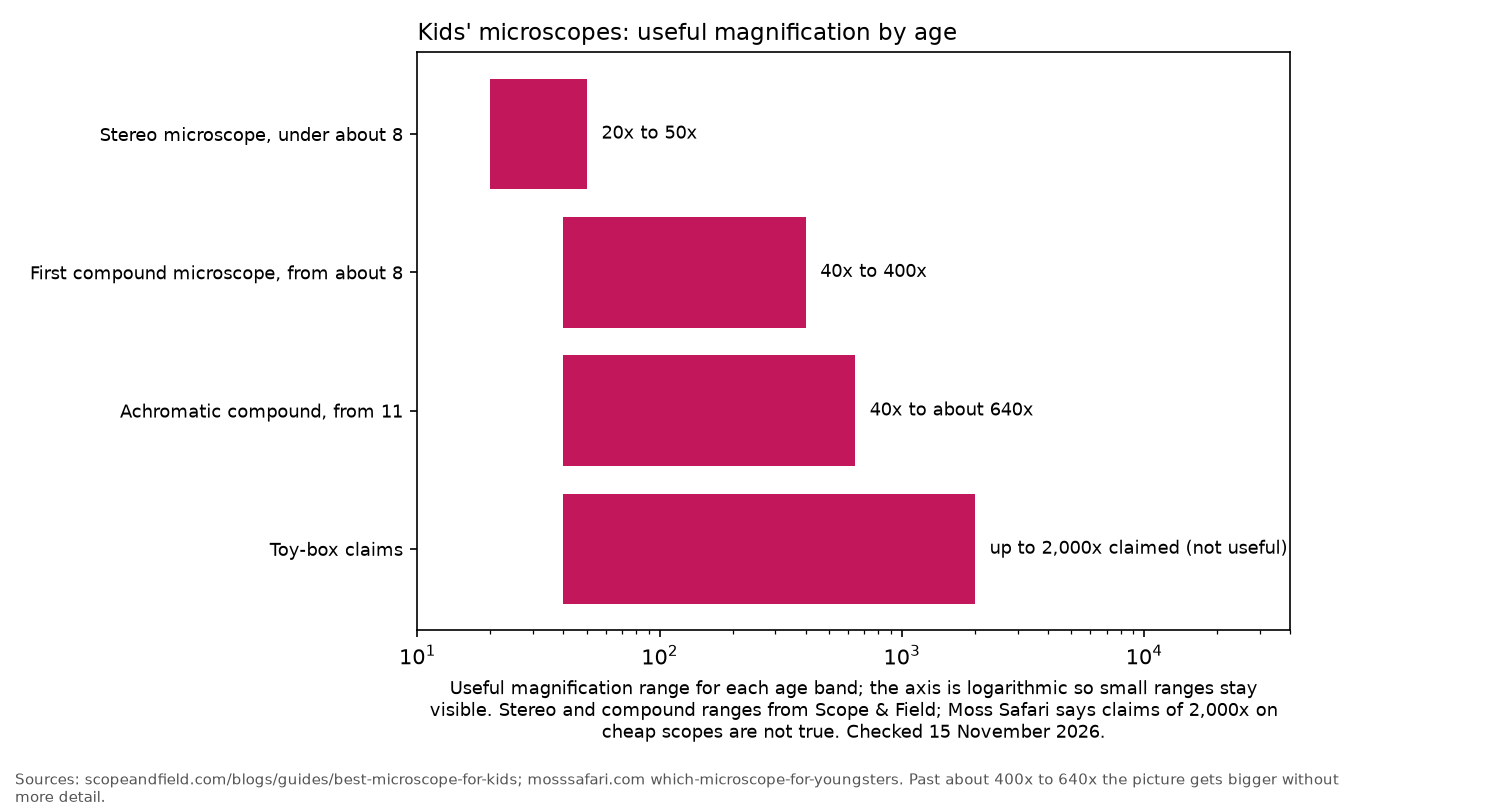
What matters when you choose
- Stereo or compound. A stereo microscope uses light from above to show whole, solid objects in 3D at low magnification. A compound microscope shines light through a thin slide from below, making it possible to see cells (Scope & Field).
- Glass, not plastic, lenses. Clear lenses and good lighting make more difference than impressive magnification claims on the box.
- Lights above and below. Lighting from below helps with slides. Lighting from above is useful for leaves, coins and insects. Many beginner microscopes offer both.
- Power. Battery-powered models can go outdoors. Check what's included, as two of these picks need AA batteries purchased separately.
- One eyepiece or two. Scope & Field recommends a single angled eyepiece for children using a compound microscope, as it's easier to look through. Stereo microscopes have two eyepieces.
The picks
Bresser Junior Stereo ICD-Pro: best for under 8s
The Bresser Junior Stereo ICD-Pro offers 20x and 50x magnification, with two pairs of eyepieces and LED lighting from above and below. According to its Amazon UK listing, it also comes with 12 mineral samples. It needs two AA batteries, which aren't included.
Scope & Field's recommendation for under 8s centres on Bresser's Junior stereo microscope, with 20x to 50x magnification. There's enough space beneath the lens for objects such as a stone or snail shell.
Who it's for: younger children who love collecting things from the garden and want a closer look. Who it isn't for: children hoping to see cells, which a stereo microscope cannot show.
No Amazon button for this pick.
National Geographic Stereo Microscope 20x: under 8s on a budget
Made by Bresser, this is a lighter, simpler stereo microscope. The listing specifies 20x magnification, LED lighting from above, adjustable eye distance and 12 mineral samples. It also requires two AA batteries.
The box-contents line on the UK listing is in German, so check the language of the manual before you order. This listing is sometimes sold via Amazon Global Store; check import charges at checkout.
Who it's for: children taking their first close look at bugs and stones. Who it isn't for: those keen to explore prepared slides, as there's no light from below.
Bresser Biolux SEL: best for about 8 to 11
The Bresser Biolux SEL is Scope & Field's alternative recommendation for an 8-year-old. It has lighting above and below, with a dimmer to adjust the brightness.
Scope & Field lists 10x and 20x eyepieces, three objectives giving 40x to 800x magnification, and a Barlow lens that takes it up to 1,600x. Three AA batteries are included, but there's no mains power option.
There's also a practical limit to what fits beneath the lens. Scope & Field says the space under the top light is about 4mm, enough for a leaf or coin but not a pebble.
The Amazon listing also includes a smartphone holder for taking photos and a starter set of samples. This listing is sometimes sold via Amazon Global Store; check import charges at checkout.
Who it's for: children ready to explore prepared slides, cells and pond water. Who it isn't for: families who prefer mains power for longer microscope sessions.
Levenhuk Rainbow 50L PLUS: best for 11 to 14
For a child who has already shown a lasting interest in microscopy, Scope & Field suggests the Levenhuk Rainbow 50L PLUS.
The UK listing gives 64x to 640x and 1,280x. It also describes dual LED lighting with brightness control, battery power and a carry case.
It also includes Levenhuk's K50 experiment kit, with prepared slides, a brine shrimp hatchery and a microtome. Scope & Field says the microtome is a small tool for cutting very thin slices, and that an adult should help with it.
Scope & Field says detail stops increasing above about 640x. Scope & Field also highlights the Rainbow 50L PLUS's achromatic lenses and metal body. One specification line on the UK listing says a plastic body, and the product description on the same listing says a metal body, so the body material is not consistent there.
Scope & Field's first-choice Rainbow 2L and 2L PLUS models had no amazon.co.uk listing that could be found. The button below opens the Moonstone colour of the 50L PLUS. The listing title says the illustrated guide is in Polish.
Who it's for: secondary school biology and home educators working through cells. Who it isn't for: younger children, who will generally find stereo microscopes easier.
Bresser Biolux NV: best for sharing on a screen
The Bresser Biolux NV is a compound microscope with an HD eyepiece camera. According to the listing, it sends pictures and video at 1280 by 720 to a PC, so more than one child can see what's under the lens. The listing title names Windows 10 and 11.
It has lighting above and below, a mechanical stage, 5x and 16x eyepieces, and 4x, 10x and 40x objectives. Power comes from three AA batteries, which are included.
Don't be swayed by the headline 1,280x magnification. The same guidance on useful optical magnification still applies.
Who it's for: home education groups and siblings who want to explore specimens together. Who it isn't for: children looking for a simple microscope to carry outdoors.
Jiusion 60 prepared slides: slides to start with
This set contains 60 labelled, prepared plastic slides showing plants, insects and animal tissue. The listing also says the plastic slides have smooth edges, and that they are smaller than a standard slide, about 60 mm by 21 mm. This set is sometimes sold by a third-party seller; check the seller and delivery at checkout.
Scope & Field recommends starting with prepared slides. They give children a chance to see what a properly prepared specimen looks like at each magnification before making their own.
Homeschool box: five easy first observations
Scope & Field's first-week suggestions are a good place to begin. Here are five observations, starting with roughly the easiest.
- Salt and sugar crystals. Put them dry on a slide and compare their shapes at 40x.
- A hair. Compare hairs from two different people, or from a person and the dog, side by side.
- Pollen. Tap a little from a flower onto a slide.
- Onion skin. Lay it flat in water beneath a cover slip. A drop of iodine reveals the nuclei at 100x. An adult should add the iodine because it stains and is harmful if swallowed.
- Pond or puddle water. Leave it standing on the windowsill for a day. At 100x, there will be something moving. Wash hands afterwards.
For more home education ideas, visit the Homeschool hub, browse science kits by age, explore educational Christmas gifts or compare home education curriculum options.
FAQ
What magnification does a child need?
For whole objects, 20x to 50x on a stereo microscope is useful. For cells, look for 40x to 400x on a compound microscope. Higher magnification rarely reveals extra detail on children's models.
Stereo or compound microscope for kids?
A stereo microscope is generally better under about 8, as it shows solid objects in 3D. From about 8, a compound microscope is better suited to slides and cells.
Are toy microscopes worth it?
Rarely. Scope & Field says a fixed plastic lens and torch produce a blurry image above about 100x.
What age can a child use a microscope?
Scope & Field suggests children can start from about five with an adult alongside. From about eight, they can generally use one independently.
What slides should we buy?
Begin with a set of prepared slides. Once children are familiar with them, add blank slides and cover slips for making their own specimens.
More from In the Trenches of Motherhood: Homeschool · How we review